
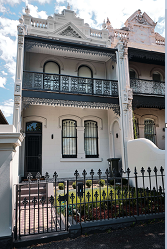
Not all heritage homes are built the same.
From the street, they might blend into one beautiful terrace row.
But structurally?
They’re completely different animals.
And if you restore them the same way, you’ll get very different — and often very expensive — results.
Understanding the era isn’t academic.
It’s strategic.
Victorian Homes (1840s–1890s): Ornate but Vulnerable
Victorian homes are defined by elaborate plasterwork, decorative iron lacework, high parapets and solid brick construction.
They were built for durability.
But they were also built using lime mortar and breathable materials.
Heritage Victoria consistently emphasises that replacing lime-based materials with hard cement renders traps moisture inside brickwork. Over time, that accelerates cracking, salt damage and internal decay.
Many “quick fixes” on Victorian façades end up shortening the building’s life rather than extending it.
That’s one reason why properly restored Victorian terraces in suburbs like Carlton and Fitzroy command strong buyer interest. Scarcity plus craftsmanship equals defensible value — a dynamic clearly illustrated when you examine why period homes consistently outperform modern builds in established suburbs.
Edwardian Homes (1901–1915): Timber, Light and Movement
Edwardian homes often incorporate more timber detailing, simpler ornamentation and broader verandahs compared to late Victorian styles.
They also move more.
Timber framing, weatherboard cladding and subfloor ventilation issues create different restoration challenges.
According to the Australian Institute of Architects, early 20th-century homes require careful structural assessment before cosmetic restoration begins, particularly in relation to stump movement and subfloor moisture.
Fixing cracks without fixing movement?
That’s repainting over a problem.
Federation Homes (1890s–1920s): Brickwork and Complexity
Federation homes often combine brickwork patterns, terracotta detailing and complex roof forms.
Beautiful.
But intricate.
Roof leaks in Federation homes can travel through concealed cavities before appearing internally, making early detection critical.
The Building Commission of Victoria has previously highlighted that older tiled roof systems require periodic maintenance to prevent long-term structural damage.
Miss that maintenance window, and the repair bill grows exponentially.
Why Era-Specific Knowledge Protects Value
CoreLogic data consistently shows established inner and middle-ring suburbs with intact period streetscapes continue to demonstrate strong long-term capital performance.
But that performance depends on preservation.
If one property in a streetscape is poorly altered, it affects visual cohesion.
The Australian Housing and Urban Research Institute has noted that neighbourhood character consistency supports property value stability.
Era-specific restoration isn’t about perfectionism.
It’s about protecting the integrity of the entire architectural ecosystem.
The Mistake Most Owners Make
They treat “heritage” as one category.
It isn’t.
Victorian plaster behaves differently from Edwardian timber.
Federation brickwork responds differently to moisture than both.
Using generic contractors unfamiliar with period construction methods often leads to inappropriate materials, trapped moisture and avoidable structural deterioration.
And deterioration erodes both physical fabric and market confidence.
Restoration as Strategy
When restoration respects era-specific construction methods:
• Materials perform as intended
• Moisture moves correctly
• Structural stress is reduced
• Original detailing is preserved
• Buyer confidence increases
And buyer confidence drives premium.
That’s not nostalgia.
That’s market behaviour.
The Bigger Picture
Melbourne’s architectural identity wasn’t built in one decade.
It evolved across eras.
Each era left its own construction techniques, vulnerabilities and strengths.
Restoring a Victorian home like a Federation one is like servicing a vintage car with modern shortcuts.
It might look fine briefly.
But it won’t perform long term.
And in a city where architectural authenticity directly influences value, understanding the era isn’t optional.
It’s leverage.